
The Tiny Custodians: Why Museums Trust Dermestid Beetles With Their Bones
In quiet back rooms of the world's great natural history museums, a colony of small, hungry beetles is doing some of the most delicate conservation work on Earth.
They show up to work without complaint. They never call in sick. They have no opinions about funding cuts, no ego about authorship, and no interest in lunch breaks. The museum preparator opens the lid, sets the specimen down, and the dermestid beetles get to it the way they've been getting to it for a long time — quietly, thoroughly, and with a kind of patient appetite that no machine has ever managed to replicate.
Walk into the prep lab of almost any major natural history museum — the Smithsonian, the Field Museum, the American Museum of Natural History — and somewhere behind a sealed door, you'll find a colony of Dermestes maculatus doing the work no human hand can do as gently. They are, in the most literal sense, the museum's tiny custodians.
A Very Old, Very Specific Job
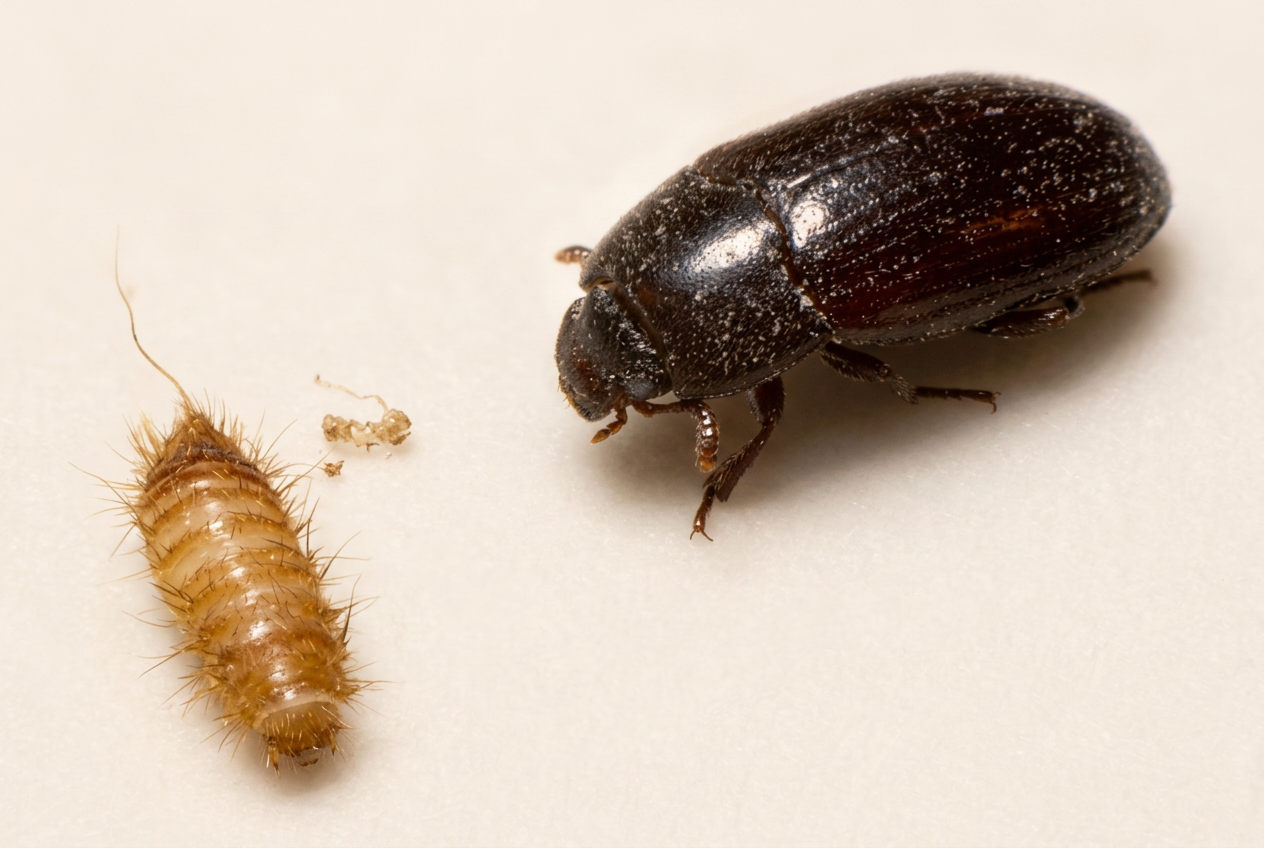
Dermestid beetles are scavengers by trade. In the wild, they show up late to the carcass — after the larger predators and the blowflies have moved on — and clean up what's left: cartilage, ligament, dried muscle, the connective tissue glued to bone. The adult beetles move in, lay eggs, and within days the larvae hatch with one job and one job only, which is to eat.
Those larvae are the workforce. They're small, soft-bodied, and tufted with golden hairs, and they will spend roughly two weeks doing little except feeding on soft tissue before they pupate and emerge as adults. The full lifecycle — egg, larva, pupa, adult — runs about 40 to 60 days at room temperature, which means a healthy colony perpetually renews itself without much help.
What makes them ideal for museum work is what they won't eat. They have no interest in bone. They can't digest it. They strip a specimen down to clean osseous structure and then stop, because there's nothing left for them. No scrubbing, no scraping, no chemical bath needed to call it done.
Why Preparators Choose Beetles Over Everything Else
A museum specimen isn't a trophy. It's a record — often irreplaceable, sometimes the only known example of a species or life stage. The cleaning method has to honor that. Boiling cooks grease into the bone and warps fragile structures. Maceration (controlled bacterial decomposition in water) is thorough but slow, smelly, and rough on small bones, which can come apart and scatter in the bath. Chemical methods — enzymes, detergents, hydroxides — work, but they soften bone, dissolve cartilage that researchers may want to keep, and risk damaging DNA.
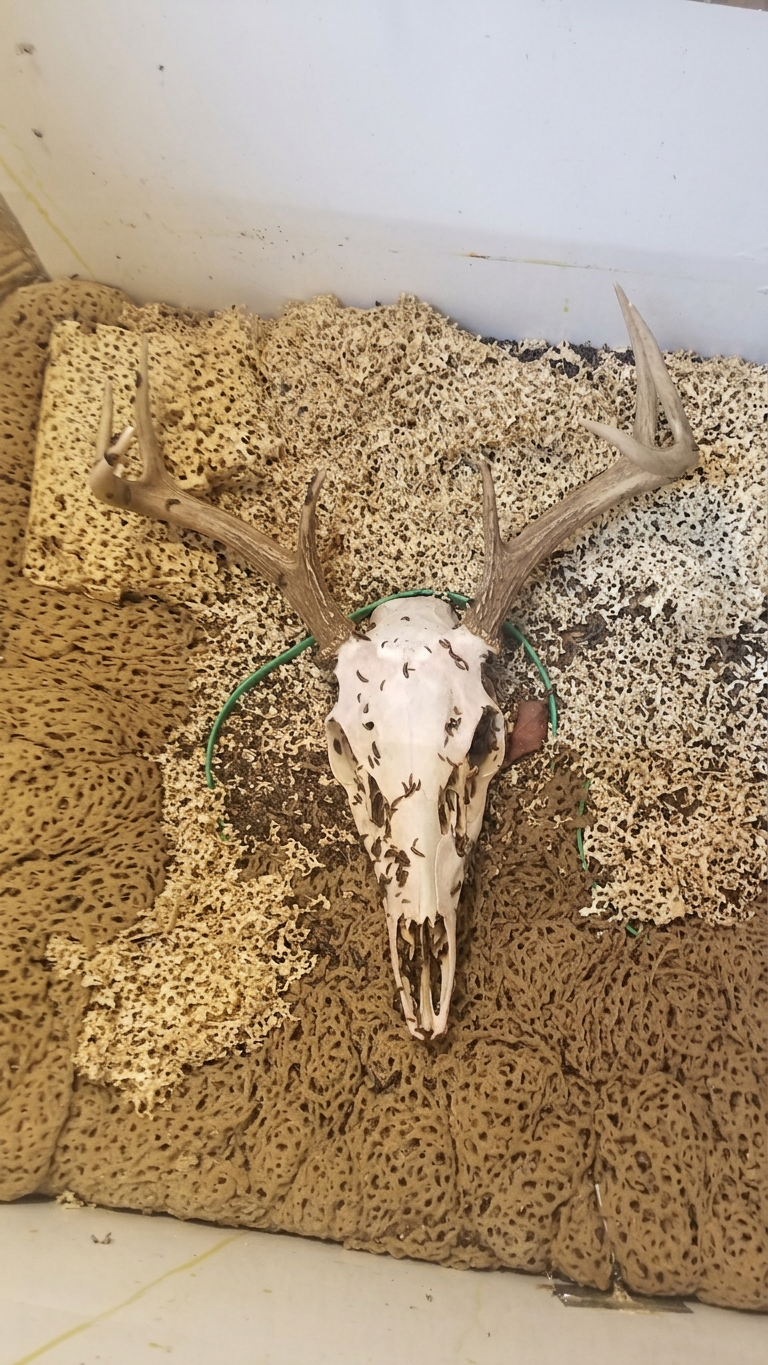
Dermestids do none of that. They reach into the auditory bullae, the nasal turbinates, the orbital fossae, the hairline sutures between cranial plates — places no probe and no toothbrush can access without breaking something. They leave articulated ligaments where the preparator wants them left. They preserve ossicles the size of a grain of rice that would vanish in a maceration tank.
- No heat damage to bone
- Reach every crevice and sinus
- Preserve fragile ear ossicles
- No grease driven into structure
- No chemical residue on specimen
- Self-renewing labor force
Time, Cost, and the Quiet Math
A medium-sized skull — say a coyote — runs about two days through a healthy beetle colony. Larger specimens, like a bear or a deer, take about three to four days. Compare that to maceration, which can stretch to a week or two for the same specimen and requires water changes, temperature monitoring, and a tolerance for smell that few institutions extend gladly.
The cost case is even quieter. Beetles eat for free. A colony needs a sealed enclosure, stable warmth, occasional cleaning, and the next specimen waiting in the queue. There's no chemical inventory, no waste disposal, no specialized equipment, and no staff time spent watching a pot. For a museum prep lab running on a public-funded budget, that math matters.
How a Colony Lives
A working colony lives in a sealed tank or chamber — usually metal-lined, sometimes a converted chest freezer or a custom stainless cabinet — kept around 75 to 80°F with moderate humidity. Adult beetles can fly if conditions are not stable, so containment is taken seriously: tight lids, fine mesh vents, sticky barriers around the perimeter. An escaped colony in the wrong room is exactly the pest problem people worry about, which is precisely why preparators don't let it happen.
Hygiene is part of the rhythm. Frass (the dry, sand-like waste the larvae leave behind) is removed regularly. Old shed skins are cleared. Specimens are pre-frozen before being introduced because it is critical to ensure unwanted pests are not introduced into the colony.
Welfare considerations aren't an afterthought. Colonies are fed consistently, kept at appropriate density, and never abandoned between projects. When a museum closes a lab or moves a collection, the colony goes with it, or it's rehomed to another institution. These are working animals, and good preparators treat them as such.
Conservation, DNA, and the Long View
Modern museum work isn't just about display cases. A skull in a research collection might be CT-scanned, sampled for ancient DNA, measured by a dozen morphometric landmarks, or compared against a type specimen collected in 1880. Anything the cleaning process destroys is gone for good.
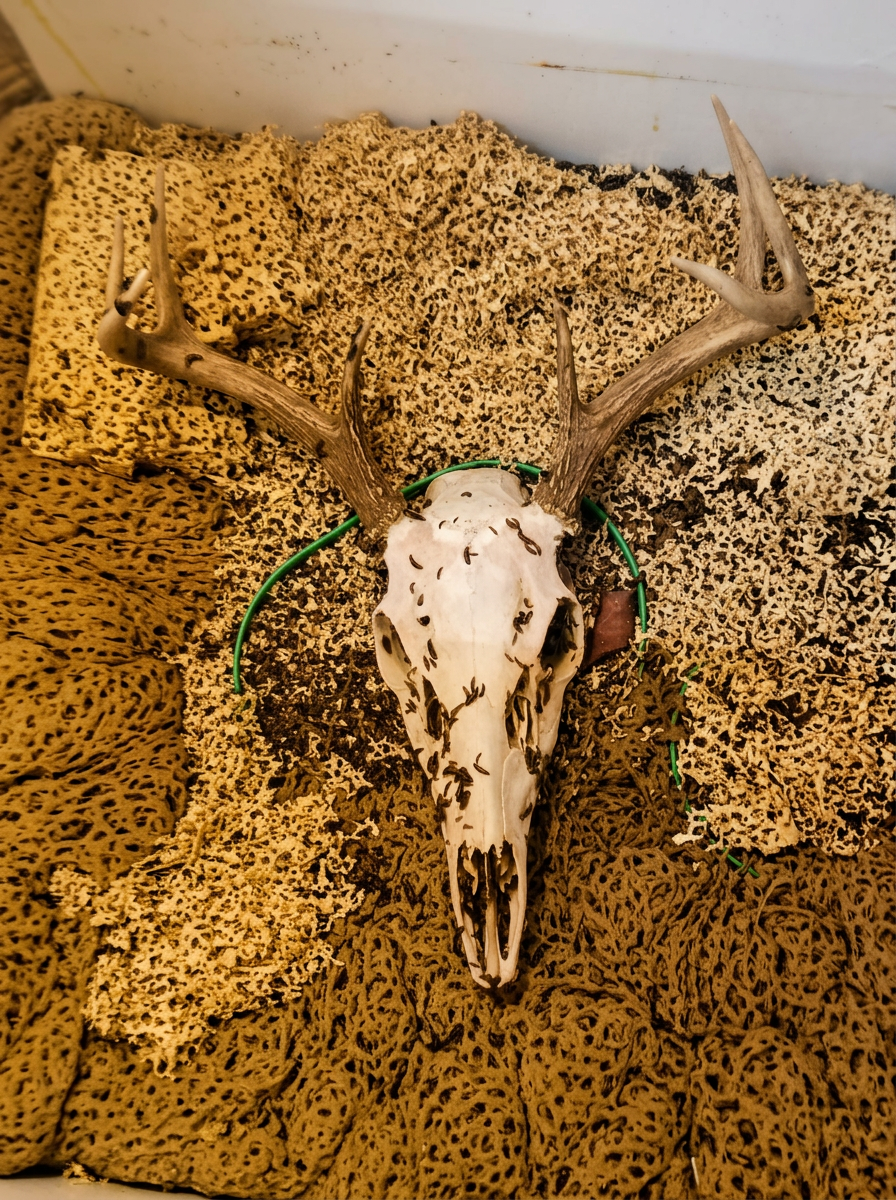
Beetle cleaning preserves microscopic surface texture — the cribriform plate, dental wear facets, healed bite marks — that chemical methods can erase. It avoids the heat that fragments DNA. It leaves the bone in a state where a researcher fifty years from now, using a technique that doesn't exist yet, can still get useful information out of it. That's stewardship measured in centuries, not seasons.
What People Worry About (And What's Actually True)
The smell
Quieter than you'd think
- A clean colony in a sealed enclosure produces very little odor
- Most of the smell people associate with bone cleaning comes from maceration, not beetles
- Pre-dried specimens can further reduce any scent during processing
The pest risk
Real, but manageable
- Dermestids will eat dry organic material — including museum textiles — if they escape
- Containment protocols, sticky barriers, and quarantine zones eliminate the risk in practice
- No major museum has lost a collection to its own beetle colony in modern memory
The speed
Slower than boiling, faster than nature
- Days to weeks per specimen, not hours
- Often slower than chemical methods, but the result is the reason
- When time matters more than detail, alternatives like enzymatic cleaning are sometimes used
When Museums Choose Something Else
Beetles aren't universal. A specimen that's been preserved in formalin or alcohol is off the menu — the chemicals ruin the colony and the beetles won't touch the tissue anyway. Very small or very fragile material (think hummingbird skulls, larval fish) sometimes goes through gentler enzymatic baths instead. And when a researcher needs a skull cleaned tonight for a presentation tomorrow, maceration with warm water and patience may be the only option.
But for the day-to-day work of building and maintaining a research-grade osteological collection, the beetles win on every axis that matters: detail, durability, cost, and respect for the specimen.
A Story From the Back Room
A preparator at a mid-sized natural history museum once described the morning a rare river otter skeleton came through the lab. It'd been salvaged from a roadside, partially decomposed, and the auditory bullae — the bony bubbles that house the inner ear — were intact but packed with tissue. Standard cleaning would've risked cracking them open or never getting them fully clear.
She placed the skull in the colony tank on a Monday. By Friday, the bullae were spotless, the tympanic ring was articulated and preserved, and the entire skull came out so clean that the mammalogist who'd requested it ran the CT scan that afternoon. Total active labor: about ten minutes of preparator time. Total cost: whatever that week's electric bill ran for the heated cabinet.
“They just do it,” she said. “You check on them, you say thanks, and they keep going.”
Stewardship, Both Ways
There's something quietly moving about the arrangement. Specimens that took millions of years to evolve, and whose survival as a record depends on careful preservation, are entrusted to a few thousand small beetles whose own evolutionary niche is exactly this: cleaning bone, gently and well.
The museum cares for the colony. The colony cares for the collection. The collection carries the species forward — into study, into display, into the long memory of the natural world. It's a small ecosystem of mutual stewardship, tucked behind a sealed door, and it works because everyone involved is exactly suited to the part they play.
The next time you stand in front of a museum skeleton and notice how impossibly clean it looks — how every suture is visible, how the inner ear bones are still in place — there's a good chance you're looking at the work of beetles. Tiny custodians. Quietly excellent. Worth a moment of thanks.
Same Beetles. Same Care.
The colony in our workshop does the same patient work for your specimens that museum colonies do for their collections.
View Beetle Cleaned Catalog